
Emergency Gate Repair Near Me: What Newport News Homeowners Should Do First
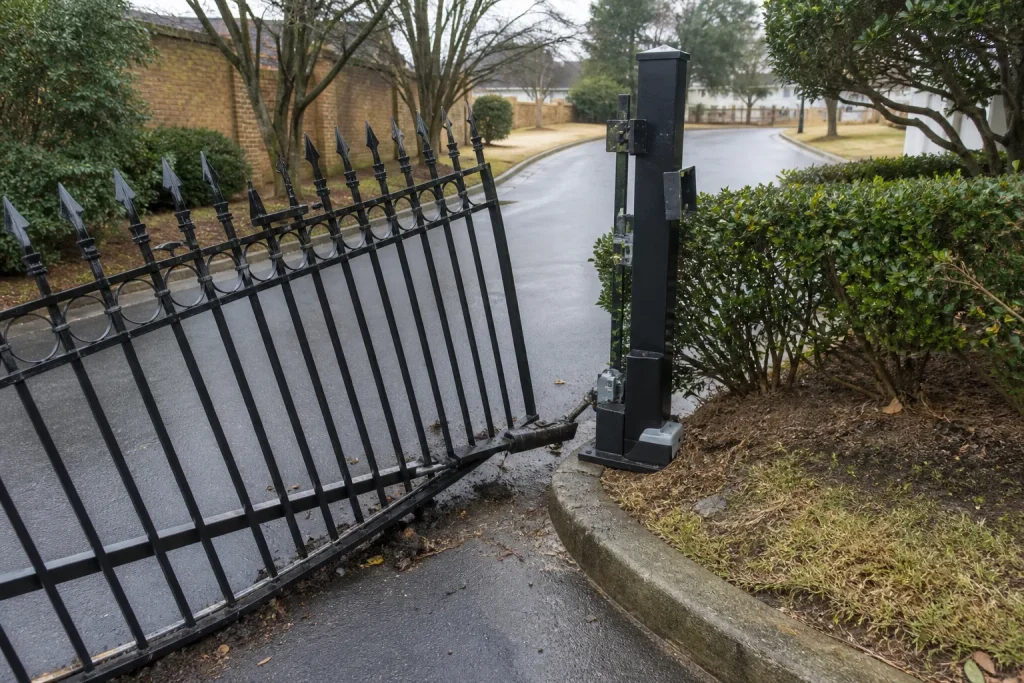
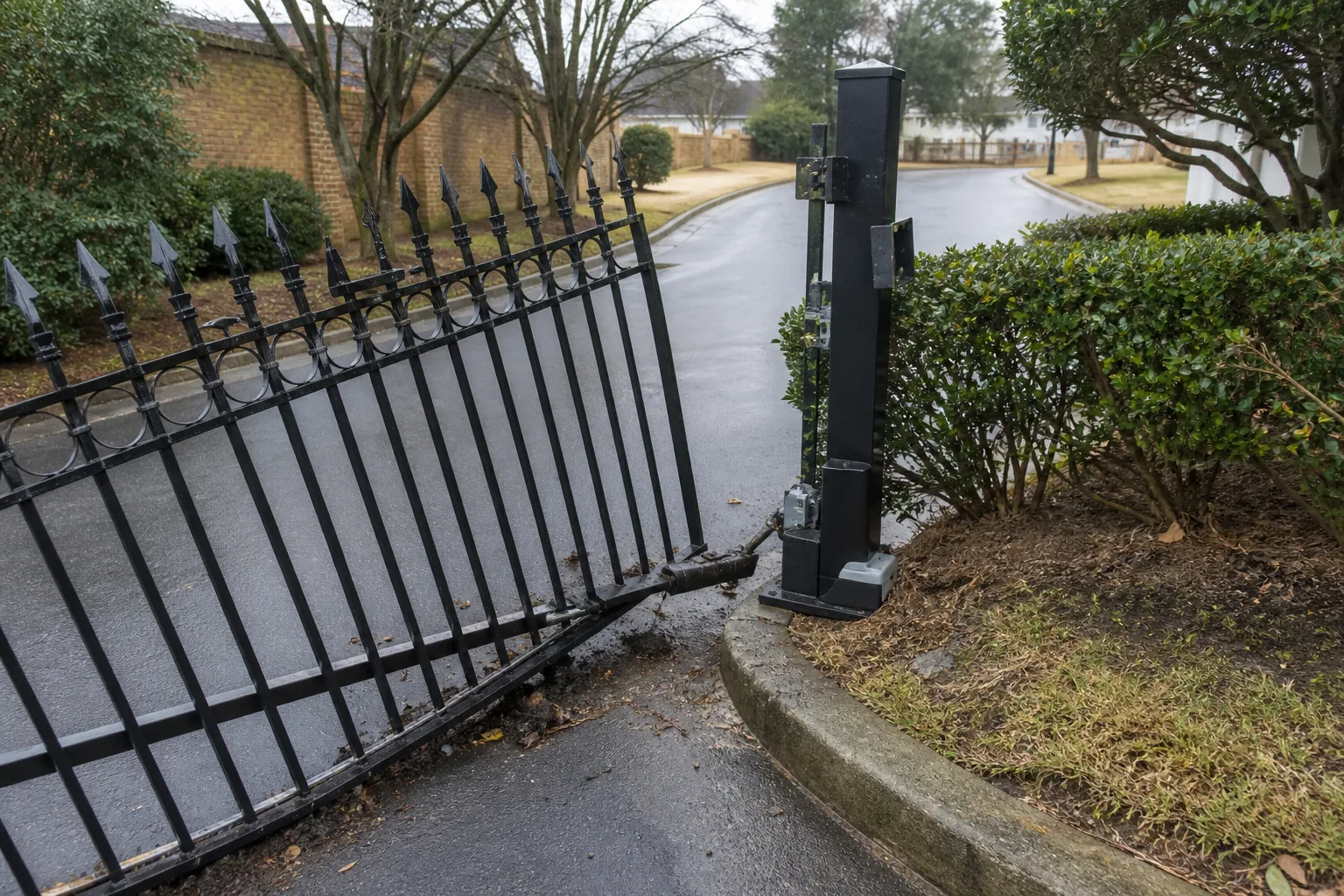
When a gate fails in the closed position, the first instinct for most homeowners is to force it open by hand. On a swing gate with a locked actuator arm, that move can bend the mounting bracket and turn a straightforward control board repair into a much bigger bracket and actuator job. The twenty minutes between a failure and a technician’s arrival are the window where the outcome is decided. What you do in that window, and what you don’t, is the difference between a quick fix and a costly one.
If you’d rather skip the troubleshooting and get a technician on the phone, call (866) 620-2654. We answer 24/7. Fast dispatch from 7am to 7pm, Sunday through Friday.
Key Takeaways
- Never force a gate open or closed before you know the operator type and release method.
- Stop, look, and listen for sixty seconds before you touch anything. That triage tells you whether it’s power, mechanical, or operator.
- Secure the gate in whatever position it’s in, don’t try to cycle it repeatedly.
- Have the operator brand, model, and failure sequence ready before you call.
Why Your First Instinct Can Make the Repair Cost More
The most common mistake we see at gates across Newport News is brute force applied to the wrong component. A gate that won’t move might have a locked actuator arm, a tripped limit switch, or a dead control board. Those are three very different problems, and forcing the gate treats all of them the same way. On a swing arm system, the actuator takes the load of the gate leaf. Push hard enough against a locked arm and the bracket that anchors the arm to the gate frame bends. The motor housing can twist. The arm itself can sheer at the pivot point.
The repair then shifts from a board swap or a reset to straightening or replacing a bracket, realigning the actuator, and re-commissioning the whole system. That’s before anyone has touched the actual reason the gate stopped working. The gate doesn’t get fixed faster. It gets fixed slower, at more expense, and with more parts.
The safer approach is to stop and identify. Look at the operator. Is it a swing arm actuator bolted to a post and connected to the gate leaf, a slide gate motor running along a track, or a barrier arm? Note the brand. If you can read a label on the housing, read it. Then leave the gate where it is and call a technician who works with the specific system on your property. Our technicians have up to 14 years of experience, and they’ve seen what forced gates do to mounting hardware. Newport News homeowners with HOA-managed common gates should also notify the HOA contact before anyone arrives, since the property may share gate access with neighbors.
The Correct Manual Release Procedure by Operator Type
The manual release procedure depends entirely on the type of operator on your gate. Using the wrong method can damage the mechanism even on a properly functioning system. Here’s how the two dominant residential types differ:
- Swing arm actuators (common with Linear, Mighty Mule, and similar residential brands): These typically have a manual release key or lever on the actuator housing. The arm releases from the operator drive, allowing the gate to swing free. On some models, you must release the arm before you can move the leaf; on others, a key unlocks a clutch mechanism. Getting the sequence backward is what bends brackets and shears pins.
- Slide gate motors (common with Ghost Controls, Viking, and similar systems): These have a manual release mechanism that disengages the drive gear from the track. Some use a lever on the motor, others a keyed release on the housing. On slide gates, the leaf also needs to be off the track before you attempt to move it by hand, and a heavy slide gate coming off its rollers is a crush hazard.
We won’t walk you through a full step-by-step release here, because the procedure varies by model and getting it wrong on a heavy gate can cause serious injury. A slide gate that comes off its track can pin someone against a wall or fence line. Swing gates have similar risks if the actuator suddenly releases under load. When in doubt, leave the gate where it is and call a technician.
If you know your operator brand, mention it when you call. We’re fluent across the brands that come up most in Newport News, including Viking, Ghost Controls, DoorKing, and Elite, along with LiftMaster, FAAC, BFT, Linear, Ghost Controls, and Mighty Mule. Recognizing the system on a property means the right parts and the right approach on the first visit rather than a return trip.
How to Secure an Open Gate That Won’t Close
A gate stuck open is a security problem, especially for a property with a rental unit, a commercial lot, or an HOA with controlled access. The temptation is to keep trying to close it with the remote or keypad, which cycles the operator against whatever fault is present and can make things worse. Instead, secure the gate in its current position.
For a swing gate, you have a few non-destructive options:
- Use the gate’s existing drop bolt or latch if it has one. Close the leaf by hand (slowly, without forcing it against the operator) and drop the latch.
- Tie the leaf to a fixed post with a temporary strap or rope, not a chain around the operator housing or actuator arm. Strapping to the actuator puts load on a component already under strain.
- Park a vehicle or heavy object at the gate line if the gate is at a driveway entrance and the vehicle can be moved without driving over the gate path. Never block the gate so that it physically can’t move if it suddenly powers back up and tries to cycle.
For a slide gate, don’t strap the gate to the track or let it lean against the rollers. A temporary stop block placed at the end of the track, outside the gate’s travel path, is safer. For a barrier arm gate, lower the arm by the manufacturer’s manual release if you know it; otherwise leave it and contact a technician.
If the gate is the only barrier between a public area and something valuable or vulnerable, call us and describe the situation. We can’t promise a specific response window, but we can help you decide whether it’s a true emergency or something that can wait until the next dispatch. Fast dispatch from 7am to 7pm, Sunday through Friday, means a gate that fails in the morning usually gets attention the same day.
The 60-Second Triage: Power, Mechanical, or Operator?
Before you call, run through these checks. They take under a minute and change what the technician brings on the first visit.
Check power first. This is the most common source of a “dead gate” call. Look for:
- A tripped GFCI outlet or breaker dedicated to the gate circuit. Look in the panel or at the outlet inside or near the gate enclosure.
- A disconnected or damaged low-voltage wire at the operator or control box. Something as simple as car damage, landscaping, or an animal can sever the low-voltage run.
- A safety device failure. Photocell beams, loop detectors, and edge sensors will hold the gate open or refuse to cycle if they’re obstructed, misaligned, or damaged. If you have safety edges or a photo-eye, check that the lenses are clean and aligned.
Check mechanical next. With the power off and the manual release engaged only if you’re confident in the procedure, gently move the gate leaf by hand. It should move smoothly with reasonable resistance. If it binds, scrapes, or won’t move at all, the problem is in the hardware: rollers, hinges, track obstruction, or a bent gate frame. Mechanical binding is one of the most common causes of an operator that trips or stalls.
Check operator last. If power is good, the leaf moves freely by hand, and safety devices are clear, the fault is likely in the operator: the control board, limit switches, motor, or a programming issue. Note whether the gate moved partway and stopped, whether the motor hums but doesn’t move, or whether it does nothing at all. That description tells a technician a lot before anyone arrives.
What Information to Have Ready When You Call
The quality of your call determines whether a technician arrives with the right parts and the right plan. Here’s what to have ready:
- Operator brand and model. Check the housing label. If you can’t read it, describe the housing shape and size. We service a wide range of systems, so knowing you have a DoorKing or an Elite, for example, helps immediately.
- The failure sequence. What happened right before the gate stopped? Did it stop mid-travel? Did it open and refuse to close? Did the motor make a noise? Did the keypad or remote stop working? These details point to different components.
- The last normal operation. When did the gate last work correctly? Was anything changed recently: a new remote, a keypad replacement, a power interruption, or landscaping work near the gate?
- Gate type and weight. Swing, slide, or barrier arm. Estimate or know the weight if it’s a heavy gate.
- Access requirements. For a commercial or HOA property, note gate codes or key access and who needs to be notified.
The more of this you have, the better dispatch can route the right technician with the right parts. A gate specialist with broad brand coverage reduces the downtime that comes from ordering parts after the first visit.
True Emergency vs. What Can Wait Until Morning
Not every gate failure is an emergency, and treating it like one can make it harder to get a technician out quickly. Here’s how to tell the difference.
What qualifies as a genuine emergency in Newport News:
- A gate on a commercial property is stuck open and the site is exposed after hours or during a time when the property is vulnerable.
- A security gate on a rental unit or shared-access property is stuck open, leaving the premises unprotected.
- Any situation where the gate failure creates a safety hazard: a gate leaning, a track that has lifted, or a gate arm that could fall.
What can usually wait until morning without added risk:
- A gate that’s stuck closed on a single-family driveway, with a working garage or pedestrian entry available.
- A gate that operates but makes a new noise.
- A remote or keypad that’s stopped responding while the gate itself cycles by hand or by another control.
- A gate that’s slow but still functioning.
If you’re not sure whether you’re in emergency territory, call and describe it. We answer 24/7 and can help you decide. A call outside dispatch hours is booked into the next opening, Sunday through Friday, 7am to 7pm.
When to Call a Pro
You should call a gate technician, rather than work through the problem yourself, in these situations:
- The gate is stuck and the manual release procedure is unclear or the gate is too heavy to move safely.
- The operator is silent or the control board shows a fault.
- A safety device, photocell, or loop detector is suspect.
- The gate is a gate you don’t own individually: a commercial or HOA gate where your fix may not be the permitted one.
Electric gate repair involves the operator’s wiring and power, which is dangerous to work with. A gate specialist can check the power run, safety edges, control board, and operator motor as part of a single visit. We specialize in gates exclusively, which means we’re not splitting attention between fencing, roofing, or garage door jobs. Our technicians have up to 14 years of experience, and they handle both gate repair and electric gate repair as core disciplines.
If you’d rather not DIY, call (866) 620-2654. We answer 24/7. Fast dispatch from 7am to 7pm, Sunday through Friday.
Related services in Newport News
If your gate needs more than a repair, we also handle new gate design and installation, from swing to slide to barrier arm. For the full range of what we do in Newport News, or to see our approach to Gate Repair Newport News, start here.
The Bottom Line
The right sequence when your gate fails is: stop, check power, check mechanical, check the operator, secure the gate in place, then call. Don’t force it. Have the brand, model, and failure description ready. A gate specialist who recognizes your system on the first visit is worth more than a quick DIY fix that turns into a bracket and actuator job.
If you’re in Newport News and need help, Gate Repair Newport News offers free estimates. Call (866) 620-2654. We answer 24/7. Fast dispatch from 7am to 7pm, Sunday through Friday. The price is quoted and agreed before any work starts.
Frequently Asked Questions
Do not force the gate past the operator’s resistance. On a swing gate with a locked actuator, forcing the leaf can bend the mounting bracket and damage the actuator, turning a smaller repair into a larger one. Instead, use the manual release for your operator type if you know it, secure the gate in place, and call a technician to assess the cause.
A 60-second check tells you a lot. If the gate won’t cycle and the operator is silent, check the GFCI, breaker, and low-voltage wire first. If safety devices like photocells or loop detectors are obstructed or misaligned, the gate will often hold open or refuse to cycle. If the leaf binds when moved by hand with the power off and the release engaged, the problem is mechanical: rollers, hinges, or track. If the leaf moves freely and power is fine, the operator or control board is the likely fault.
Have your operator brand and model from the housing label, the failure sequence, what was happening right before the gate stopped, the last time it worked normally, and whether the gate is swing, slide, or barrier arm. If you’re on a commercial or HOA property, have access codes or contact info ready. Call (866) 620-2654 for an exact quote. Estimates are free.
We work with both residential and light-commercial gate systems, including operator and access control brands like DoorKing and Elite. If you’re not sure whether your system falls under that category, describe it when you call and we can tell you whether we can help.
Written by the team at Gate Repair Newport News.
Need Gate Repair Help?
Call Gate Repair Newport News - licensed & insured, here with fast help in Newport News.
(866) 620-2654